How it works?
Hack the Stars is an MMO where you build a machine, not a class. Every infiltration obeys light-latency physics, planetary power grids, and the six-stat System Hex driving the A.I.D.A. motherboard.
CPU · RAM · Network · Firewall · Cooling · Integrity. Swap chips, pivot roles instantly.
0.5s global cooldown, movement consumes RAM, heat defines how hard you can push.
Each planet throttles hardware versions and slots so veterans can squad with rookies.
Solo contracts, 2-4 player squads, 8-player tactical ops, and 45-player Wormhole Trials.
Operation Cycle
Missions are deliberate. Each step exposes different systems, from recon intel to reinvesting the spoils.
Select Mission
Choose contracts from dozens of planets. Each has unique biome, economy, infrastructure and rewards.
Configure AIDA
Load exploits, patches and daemons. Adjust your hardware for the planet's Power Grid Rating.
Deploy & Infiltrate
Hex-grid tactical combat. Exploit network vulnerabilities. Every decision matters.
Extract & Upgrade
Loot resources, craft better hardware, unlock new planetary systems. Repeat with more power.
AIDA Combat Stack
Real-Time Combat
Combat follows the real-time + cooldown structure. Exploits cast between 0.8s and 3s, patches resolve in 0.5-2s, movement takes 0.5s per node hop, and every action respects a 0.5s global cooldown. Builds are about sequencing casts, weaving instant daemon toggles, and riding the network speed curve instead of waiting for turns.
Network Node Battlefields
Engagements take place on living network topologies. ICE nodes, routers, and trace probes constantly re-route paths. Range is measured in nodes, with damage falloff at −15% per hex beyond your Network stat. Diagonal hops, and choke control matter as much as DPS, because every mission remix rewires the battlefield.
Heat & Resource Pressure
Heat is a physical threat with two thresholds: 80% triggers throttling, 100% forces shutdown. Cooling bleeds heat at (Cooling ÷ 20) per second, RAM drips back at 3% per second, and Firewall crawls at 1% per second. Patches like Buffer Reload or Heat Sink Purge act as panic buttons. Combat is about sequencing: spend CPU for burst, dump heat with Cooling, and never let RAM hit zero or you literally stop acting.
Exploits (Attacks and Debuffs)
Burst, DoT, execute or AoE abilities that convert CPU into immediate impact. They spend RAM, spike Heat, respect execution times, and scale from Tier 1 tutorial tools (Buffer Overflow, SQL Injection) up to endgame ultimates like Zero-Day and Fork Bomb.
Patches (Heals and Buffs)
Single-version lifesavers tied to Power Grid. Garbage Collector refunds RAM, Kernel Patch restores Integrity, Firewall Flush rebuilds defenses, and Heat Sink Purge instantly dumps Heat to avoid forced shutdowns.
Daemons (Processes)
Persistent background processes that consume RAM continuously. Toggle Intrusion Detection for evasion, Bandwidth Optimizer for cast speed, or Overclocking for +25% damage at the cost of Heat. Slots are scarce — deciding which daemons stay online defines a build.
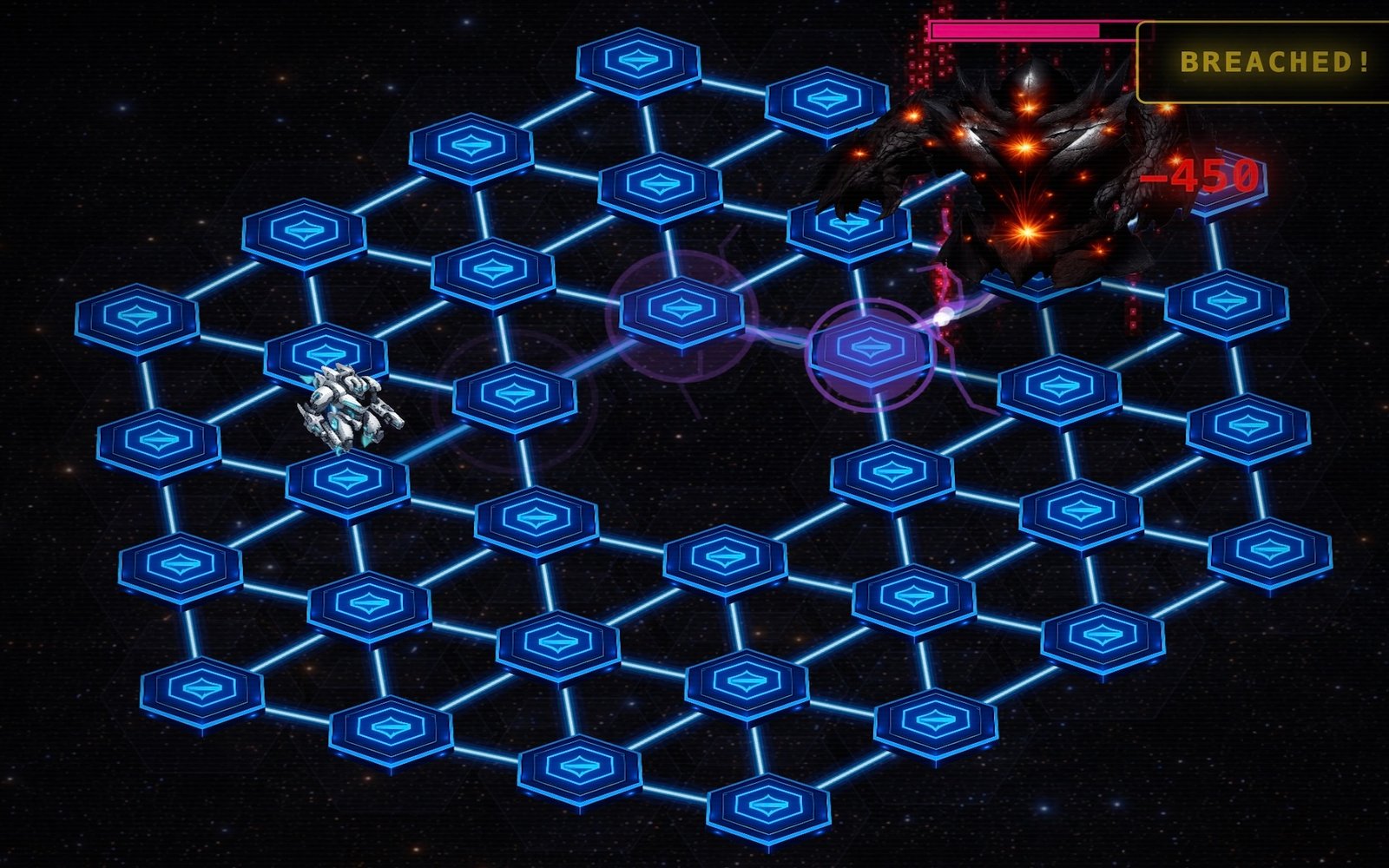
Combat Metrics
- Global cadence: Real-time tick, 0.5s GCD on every cast
- Movement: 10 RAM per hop, 0.5s travel, diagonal allowed
- Range: Network defines 100% damage radius, −15% per extra hex
- Heat thresholds: 80% throttling, 100% forced reboot
- Regen: RAM +3%/s, Heat −(Cooling ÷ 20)/s, Firewall +1%/s
The System Hex
No classes. No abstract levels. Swap components to pivot your entire combat role.
The A.I.D.A. chassis ships with six mandatory bays,
a controller backplane, and a multi-slot roadmap. Build identity comes from silicon — swap chips, gate heat,
and obey whatever Power Grid the planet allows.
CPU — Power / Attack
Exploit damage & firewall penetration
CPU defines how fast and how hard your exploits land. It's raw damage amplification, cast speed, and firewall penetration in one stat. More CPU melts bosses but skyrockets heat.
- Glass Cannons: Chain Zero-Day bursts, rely on Cooling teammates
- Boss Killers: Execute windows thanks to penetration bonuses
- Speed Runners: 2s casts drop to 1s with sufficient CPU
RAM — Capacity / Sustain
Daemon budget & ability uptime
RAM is concurrency. It fuels exploits, keeps daemons online, and even gates how many targets you can affect. Hit zero RAM mid-op and you literally stop moving until regen kicks in.
- Daemon Masters: Sustain 6+ persistent buffs without collapsing
- Support Arrays: Spam patches, keep Firewall flushes off cooldown
- Stability Builds: Resist stuns and trace spikes with RAM buffers
Network — Range / Mobility
Signal radius & node hop speed
Network defines movement speed, range, and how fast Trace stacks climb. Low bandwidth means melee hacking.
- Sniper Links: 5+ node reach and safer exfiltration timers
- Support Relays: Project buffs and patches from another lane
- Signal Architects: Pull Trace from allies, redirect aggro
Firewall — Defense
Damage soak before Integrity
Security chips absorb punishment before Integrity drops. Firewall regenerates slowly, can be bypassed by specialized exploits, and is where tanks store their mitigation tools.
- Fortified Chassis: Passive regen 10-15 per turn
- Adaptive Shields: Resist trace & debuffs
- Hybrid Plating: Mix defense with utility sockets
Cooling — Heat Management
Sustain aggressive rotations
Cooling governs how fast Heat dissipates and when throttling kicks in. At 80% Heat you lose cast speed; at 100% the motherboard hard resets. Cooling gear dictates whether you can spam Zero-Day or must kite for 5 seconds.
- Budget Air: Safe but forces downtime
- Liquid Loops: Comfortable mid-tier sustain
- Cryo Arrays: Enable zero-day spam without meltdown
Integrity — Chassis
Crash threshold & survivability
Integrity is the chassis itself. Most planets fix this value; only controller chips or rare chassis upgrades move it. Hit zero and you crash, triggering a relay respawn or a wipe if you're in timed content.
- Reinforced Kernels: +10-15% max Integrity
- Failover Routines: One-time self revive
- Adaptive Chassis: Trade Heat/RAM for extra HP
Motherboard & Controller Bay
The chassis always runs one chip per stat, but the controller backplane is where builds turn wild. Controller slots unlock via blueprints (0 at start, +1 during early game blueprint mission, +3 more across yearly expansions), and anti-synergy rules prevent stacking the same category twice.
- Only one slot max at launch. Later expansions go up to four, but Power Grid caps how many stay active per planet.
- Aegis Controller: Caps Network at 2 nodes and boost Firewall, creating true melee tanks.
- Phantom Protocol: Burns 30% of your CPU pool to reduce Trace, letting stealth builds stay invisible.
- Overclock Array: Trades Cooling headroom for bursty CPU spikes; the colder you run, the harder your next exploit hits.
Dual Progression Curve
Every module is defined by Tier (C → B → A → S) and Version Level (v1+). Multi-slot blueprints let you stack duplicate chips with diminishing returns, but Power Grid throttles both version and the number of active multi-slots. A v20 CPU inside a v5 planet instantly downgrades to v5 with excess multi-slots shut off.
Tier Benefits
Version Scaling
Each version adds +10 base to the stat. A Security Chip v10 provides 100 base Firewall before rarity multiplier.
Combined Formula: Final Stat = Version × 10 × Tier Multiplier
- C v1 CPU: 10 × 1.0 = 10 CPU
- S v1 CPU: 10 × 3.0 = 30 CPU
- B v10 CPU: 100 × 1.5 = 150 CPU
- S v10 CPU: 100 × 3.0 = 300 CPU
Multi-Slot Era
Multi-Slot unlock with expansions and contribute less per duplicate. It's mode slots for the same stat. Slot 1 = 100%, Slot 2 = 60%, Slot 3 = 40%, Slot 4 = 25%. Planets cap active slots (v1-v9 allow 2 → v20-v29 allow 4), so revisiting early content still feels fair.
- Launch: 1 slot per stat (Hyperion, v1-v10)
- Origin Expansion: 2nd multi-slot unlocked (v10-v20)
- Future Expansions: 3rd and 4th slots for extreme builds
- PGR Limiter: Early planets disable extra slots automatically
Example Builds
Snapshots from the Helio era (v5 hardware, PGR 5+ planets, single-slot). Yearly expansions add more slots and higher versions, but the archetypes remain consistent.
Heat Tank
- Prioritize Firewall + Cooling to soak aggro via deliberate heat spikes
- Run Noise Generator + Trace Magnet controllers to keep enemies focused on you
- Keep Heat near 70%, purge with Heat Sink Purge to avoid shutdown
- Rely on steady Memory Leak DoTs instead of burst damage
Role: Anchor raids by attracting Trace and shrugging off overheats. Mistime purges and you hard reset.
Signal Architect
- High Network lets you intercept Trace and redirect aggro via controllers
- Maintain Intrusion Detection, Signal Jammer, and Bandwidth Optimizer simultaneously
- Buff teammates with range bonuses while throttling enemy firewalls
- Focus on uptime, not DPS — your value is stabilizing the squad
Role: Protect the group from Trace wipes and keep buffs online. Requires constant RAM awareness.
Solo Operative
- Balanced stats to clear contracts solo, including Firewall for mistakes
- Daemons: Bandwidth Optimizer, Stealth Protocol, Auto-Repair
- Kite at max Network range while rotating self-heals and cooling skills
- Prepared for Dark Sectors thanks to trace control and emergency RAM
Role: Flexible solo build capable of clearing planet rings without swapping characters.
Build Philosophy
Hardware lets you pivot roles mission-to-mission. One AIDA can go Heat Tank for Wormholes, swap chips to become a Signal Architect for raids, then refit to solo contracts — no respeccing required.
Early game (v1-v3, single-slot): Balanced stats keep you alive. Mid-tier (v5-v10): Specialize two attributes and lean on controllers. Expansions (v10+ with extra slots): Extreme min-maxing — quadruple-stack CPUs or run triple Cooling while the Power Grid throttles you down when needed.
Power Grid Rating
Every planet has a physical infrastructure cap. Power Grid Rating auto-throttles hardware versions and multi-slot counts so revisiting old content stays honest and mixed squads feel fair.
How It Works
Each planet reveals its infrastructure tier (e.g., v1, v2, etc). When you connect, the Power Grid clamps every component to the supported version and disables excess multi-slots. Tier remain untouched; Version and active slot count change automatically.
Effective Version: v10 → v2 • Inactive Slots: 2
Scenario: Veteran Enters V2 Planet
- CPU S v10 (4 multi-slots unlocked)
- Cooling A v9 (triple-stack)
- Firewall S v9
- CPU behaves like S v2 (2 multi-slots active, slots 3-4 offline)
- Cooling behaves like A v2
- Firewall behaves like S v2
Result: You still feel stronger thanks to rarity and controllers, but the numbers are proportional to locals. Squad up with rookies without trivializing the planet.
Active Slot Caps Per Planet
- V1-V9: Up to 2 active slots per stat
- V10-V19: Up to 3 slots active
- V20-V29: Up to 4 slots active
- V30+: All slots online (future galaxies)
Why This Matters
Low-Tier Content Stays Relevant
Inner-ring planets keep their challenge. Veterans revisit for biomes/economies without flattening everything.
Play With Anyone
Mixed squads sync instantly. Rookies bring v1 builds, veterans get clamped to v1 output, both still use their kits.
Horizontal Progression
Progression unlocks new slots/controllers, not just bigger numbers. Early planets disable excess slots for balance.
Clear UX
Terminal warnings explain every clamp, so players know why a build behaves differently on each world.
PGR Tiers
| Ring / Content | Grid Level | Planets | Highlights |
|---|---|---|---|
| Inner Ring | V1-V2 | 30% of planets | Onboarding, safe economies, controller blueprint quest |
| Middle Ring | V3-V4 | 50% of planets | Mixed biomes, Tactical Ops, faction economies |
| Outer Ring | V5-V6 | 20% of planets | Raids, Dark Sectors, rare blueprint drops |
| Warp Gate | V6 | 1 per system | 15-player raid gating access to the next system |
| Anomaly Breach | V10+ (Wormholes) | 1 per galaxy | 45-player multi-squad trial to unlock the next galaxy |
Solo & Group Content
Full progression solo OR group. Your choice. No forced grouping. No mandatory raids.
Solo Operations
- Intel → Planning → Payload → Exfiltration loop playable end-to-end solo
- Procedural contracts scale based on your hardware + Power Grid cap
- AI support is optional; most content balances around single operators
- Full access to crafting, markets, and controller progression
- Clean exits reward more reputation and blueprint drops
Solo builds come from balanced System Hexes or specialized controller combos. Almost everything in Hyperion can be cleared alone with planning.
Raids / Tactical Operations (2-4 players)
- Plug-and-play squads via Relays and matchmaking
- Mission modifiers encourage role diversity (Heat Tank + Signal Architect + DPS)
- Shared objectives, instanced loot or per-player options
- Dark Sectors open for opt-in PvPvE runs
- Voice chat useful, but tactical pings cover essentials
Build synergy is everything. Stack Overclocks for burst or rotate Trace Tanks to keep squads hidden.
Warp Gate Trials (10-15 players)
- Instanced raids inside system Warp Gate (PGR V6)
- Three-phase bosses, environmental hazards, relay prep rooms
- Weekly lockouts tied to cosmetic + blueprint rewards
- Power Grid equalizes hardware so strategy matters more than item level
These are the bridge between casual contracts and galaxy-defining content. Expect relays, briefing terminals, and coordinated loadout swaps.
Anomaly Breach Trials (45 players)
- Three squads of 15 operating in parallel arenas
- 30-45 minute runs unlock the next galaxy via Anomaly Breach
- PGR clamps all participants to the Wormhole's grid to keep parity
- Controller drops are disabled inside; rewards arrive afterward
- Failure resets the checkpoint for all three squads — coordination is key
The endgame spectacle. Everyone sees the same objectives, but success requires synced comms between all three squads.
Crafting & Economy
Planetary Resources
Each biome/economy pair spits out unique loot tables. Inner rings feed industrial ores, middle rings drip biomatter, outer rings drop exotic matter and rare controller blueprints. Early-tier materials stay relevant because top-tier fabrication still consumes them.
- Circuit Fragments & Quantum Lattice for physical hardware
- Blueprint drops tied to economy type
- UNT currency from Dark Sectors for PvP gear
Blueprint Fabrication
Blueprints are consumable schematics. You spend data fragments and credits to 3D-print one chip. Reverse engineer unwanted gear back into fragments, or chase RNG ranges for min-max builds.
- Blueprint + Specific fragments + Credits = 1 chip
- Slot upgrades and controllers demand premium fragments
- Reverse engineering turns chips back into fragments (one-way)
- No crafting failures, but stat ranges keep the hunt alive
Player-Driven Market
Auction houses, direct trades, and commission work fuel the economy. No pay-to-win; the hustle is about arbitrage, speculation, and fulfilling build orders.
- Sell blueprints, fabricated chips, or raw fragments
- Contract crafters for controller builds
- Speculate on upcoming systems visible on the star map
- Use UNT (PvP currency) for black-market exclusives
Economic Loop
1. Run Contracts
Target biomes/economies for specific fragments & credits.
2. Reverse Engineer
Break unwanted chips to stockpile Circuit Fragments and rare materials.
3. Fabricate & Trade
Print new core chips/controllers or flip the blueprint on the market.
4. Upgrade AIDA
Equip the win or reinvest the profit into the next system.
Mission Variety
Story Missions
Progress through the main narrative or secondary content.
Difficulty: ⭐⭐⭐Procedural Contracts
Infinite contracts (data theft, sabotage, rescue) remix network layouts, ICE lineups, and optional objectives every run.
Difficulty: ⭐⭐⭐World Bosses
Planet-wide alerts spawn massive ICE entities. Open squads, persistent damage phases, faction objectives layered on top.
Difficulty: ⭐⭐⭐⭐Raids / Tactical Operations
2-4 players tackle multi-phase minios and bosses.
Difficulty: ⭐⭐⭐⭐Warp Gate Trials
15-player Trial to to open the Warp Gate to a new system.
Difficulty: ⭐⭐⭐⭐⭐Anomaly Breach Trials
45-player Trial events — three squads of 15 solve parallel objectives to open the next galaxy.
Difficulty: ⭐⭐⭐⭐⭐Endgame Content
Outer rings, Dark Sectors, and Wormhole Trials keep vets busy. Systems are meant to be revisited forever thanks to Power Grid throttling.
Motherboard Min-Max
Multi-slot builds, controller synergies, and blueprint hunting. Leaderboards track fastest clears and most efficient heat curves.
Rings & Wormholes
Outer-ring planets, Warp Gates, and Wormhole Trials unlock new systems and eventually new galaxies with unique rules.
Tactical Ops & Trials
Raids (4 players), Trials (15 players) and 45-player Anomaly Breach trials with rotating mutators, cosmetics, and blueprint rewards.
Dark Sectors
Opt-in PvP zones with UNT currency, bounty systems, and black-market hardware. Risk equals massive payouts.
Economy & Crafting
Corner markets, flip blueprints, or become the go-to controller crafter. Reverse-engineer high-tier loot for huge profits.
Factions & Influence
Push planetary reputations, unlock faction vendors, and move the political meter that decides which system opens next.
Join the Journey
Play the Demo
See the roadmap in action. Tartarus Breakout demo drops February 2026. Free, standalone, progress transfers.
Download Demo Available february 2026Wishlist on Steam
Support the algorithm. Get notified at launch. Every wishlist helps indie games compete.
Wishlist Now Never miss an update